Interlude · 1937–1998
The Captain’s Log
A leather-bound regatta trophy became a sixty-one-year record of races, cruises, pranks, and farewells: the most intimate document in Yankee’s archive.
Every history of Yankee rests finally on one object: a leather-bound album, its cover a regatta trophy, its pages a sixty-one-year conversation among the people who sailed her. The logbook runs from May 1937 to August 1998: 171 surviving pages of ship’s log entries, snapshots, newspaper clippings, charts, printed club programs, and handwritten tributes. It is at once a navigational record, a family scrapbook, a social register of Bay sailing, and a book of farewells. The custom-printed pages carry her name in letterpress across the top — “SCHOONER YANKEE ‘X3’,” her racing designation of the era — and the entries beneath run from terse to Homeric depending on the year, the wind, and the writer.
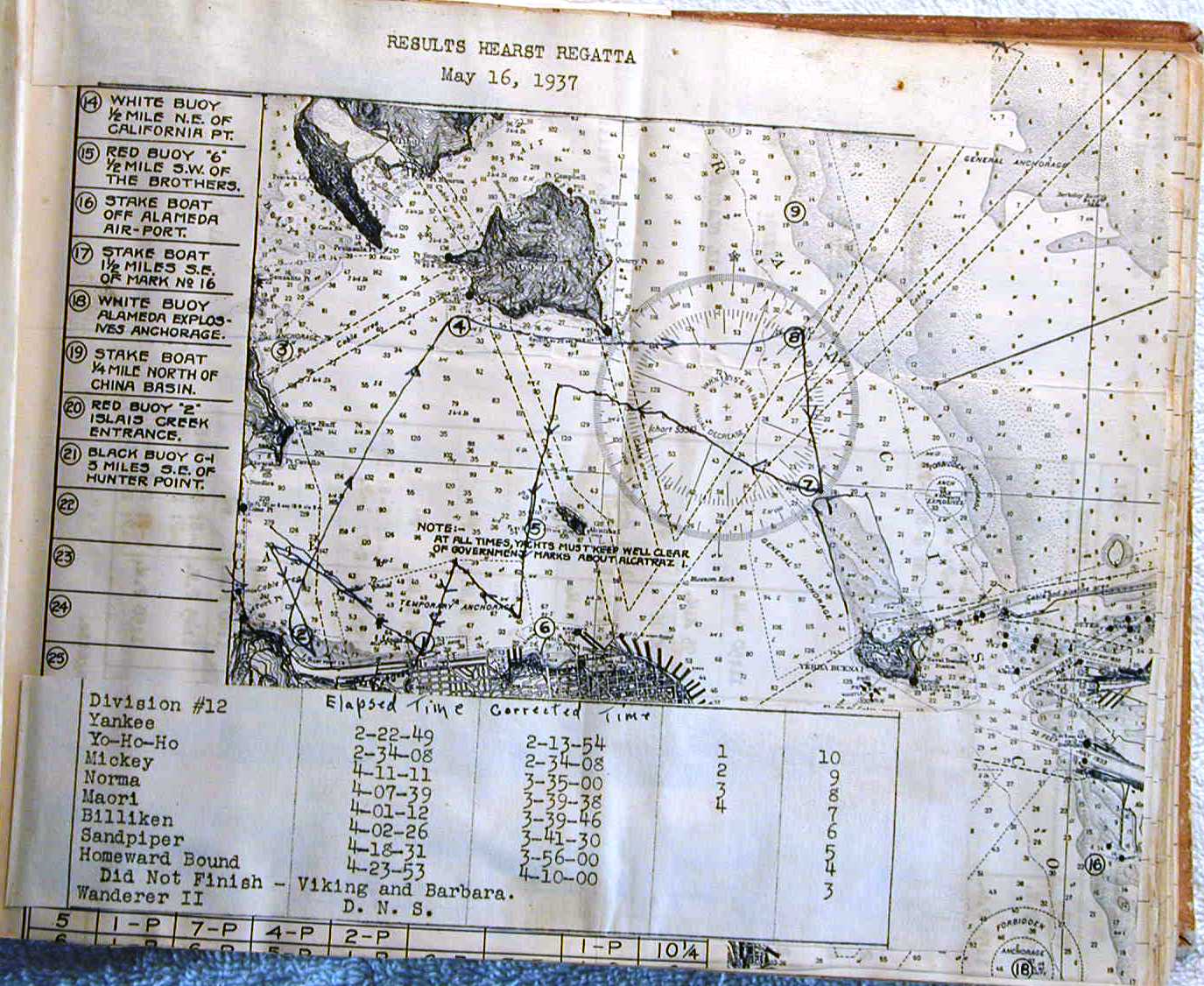
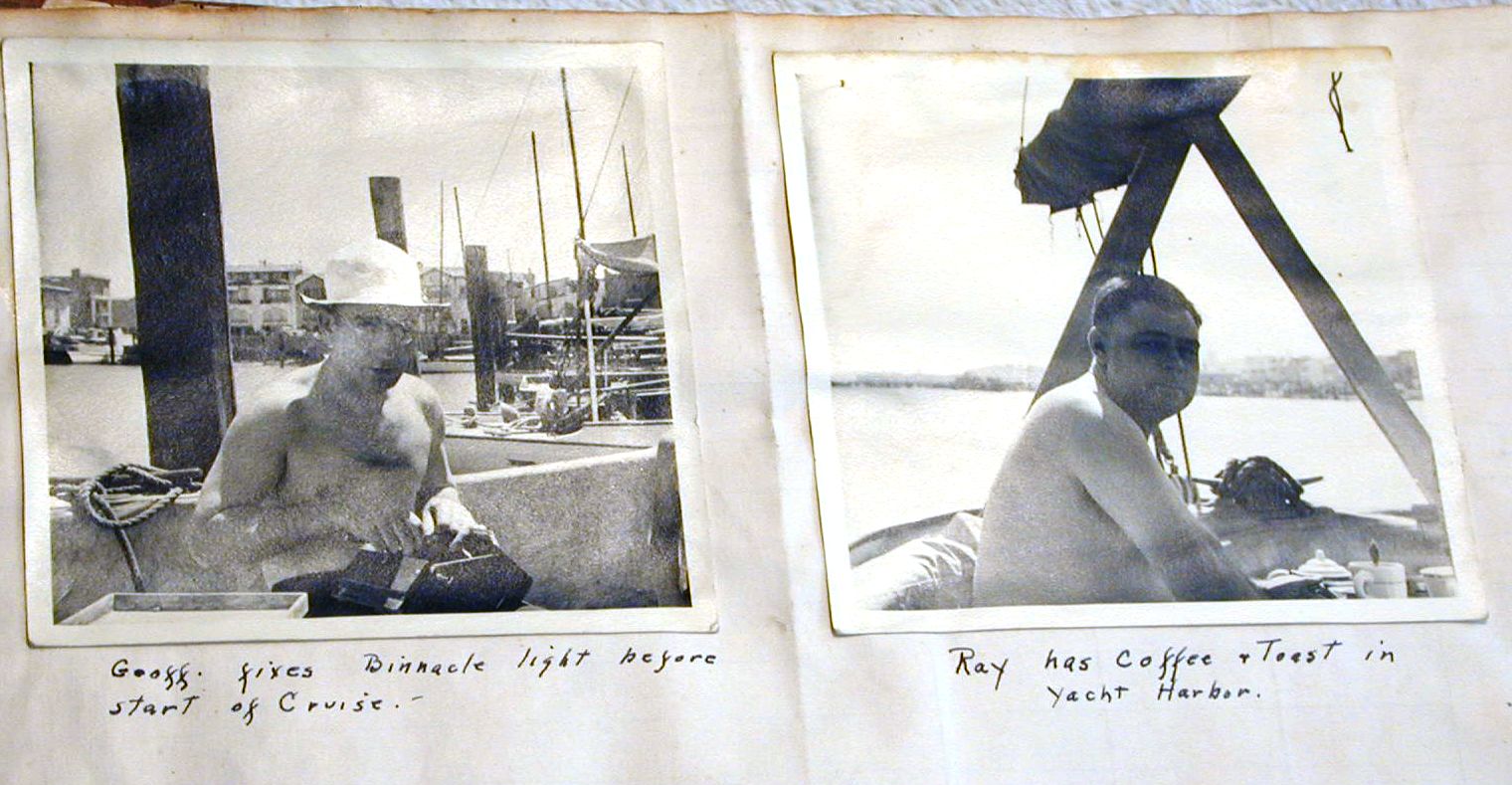
The logbook’s epic is the Southern Cruise of July 1937: three weeks from the Yacht Harbor to Santa Barbara and Santa Cruz Island and back, logged in meticulous detail — every course change, every log reading, every cocktail hour — by a crew consisting of Arthur W. Ford (“Skipper”), his brother Geoffrey, Ray Goodwin, Louie Cantell, a shipmate known as Bing, and friends joining and leaving at each port. The voyage had everything. They ran out of gas off Point Arguello at four in the morning and drifted under sail until a mechanic in Santa Barbara sorted the magneto. They crossed to Santa Cruz Island and were hosted at Prisoners Harbor by Justy Caire, whose family had run the island’s great ranch for two generations: “like an old Spanish village,” marvels the log, with its 1890 brick winery, chapel, and shearing sheds. The Caires had in fact sold the island to Edwin Stanton only three months earlier, and Stanton’s fourteen-year-old son Carey, the island’s future patriarch, appears in the log at the beach barbecue, half a lamb turning in front of the big house.
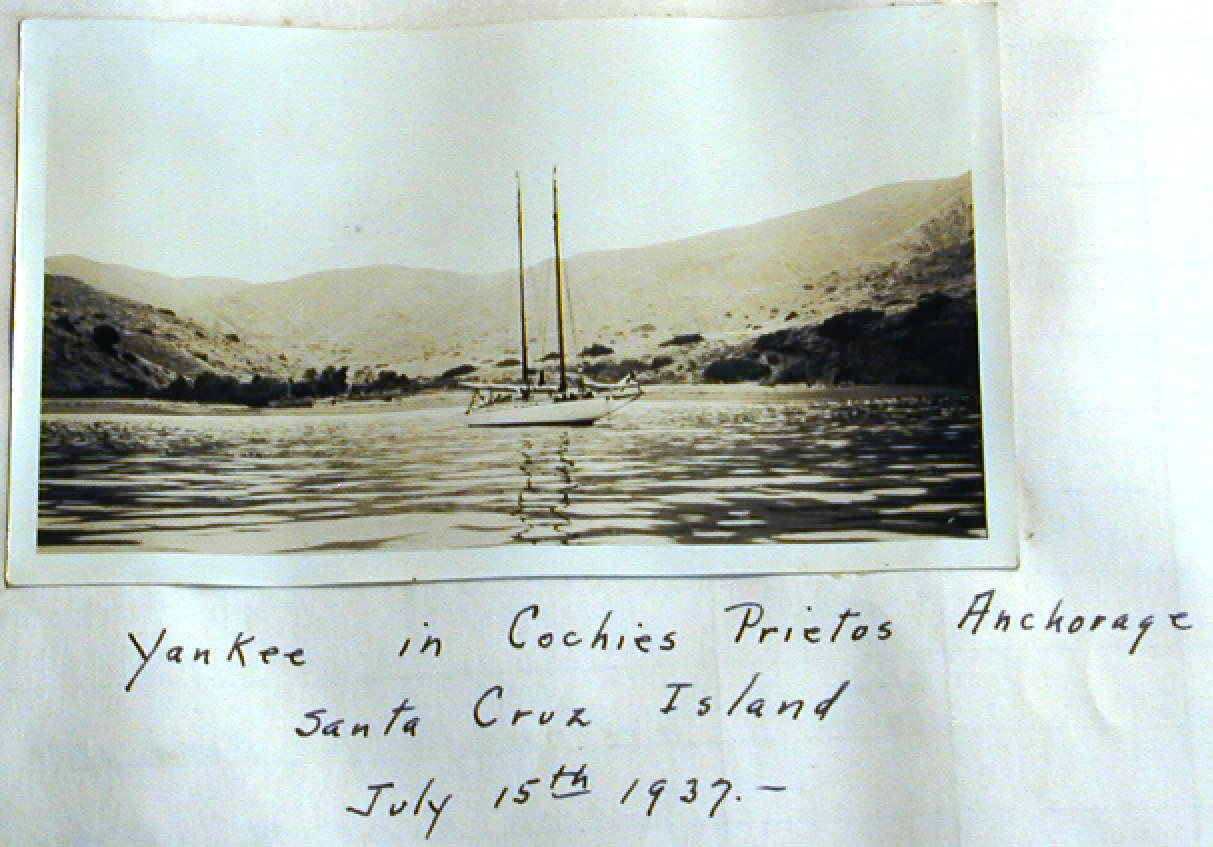
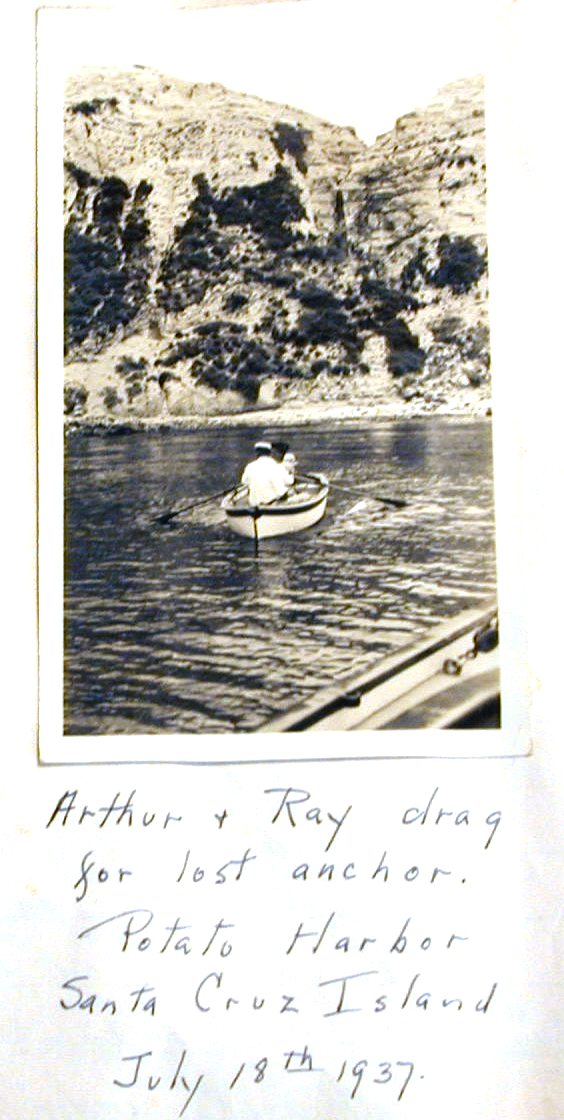
They rowed into the Painted Cave, “greeted by roaring + barking of seals... the lava formations being of all colors... inside the cave it is so dark even the long flashlights were of little help.” They anchored at Coches Prietos (the log spells it “Cochies”), where the album preserves a panorama of Yankee motionless on glass. And at Potato Harbor the anchor chain parted in a night surge: “All Hands!! Engine started — full speed ahead — missed going on rocks by small margin,” then, the next day, health regained over breakfast, Arthur and Ray rowed back and grappled up the lost gear from the bottom.
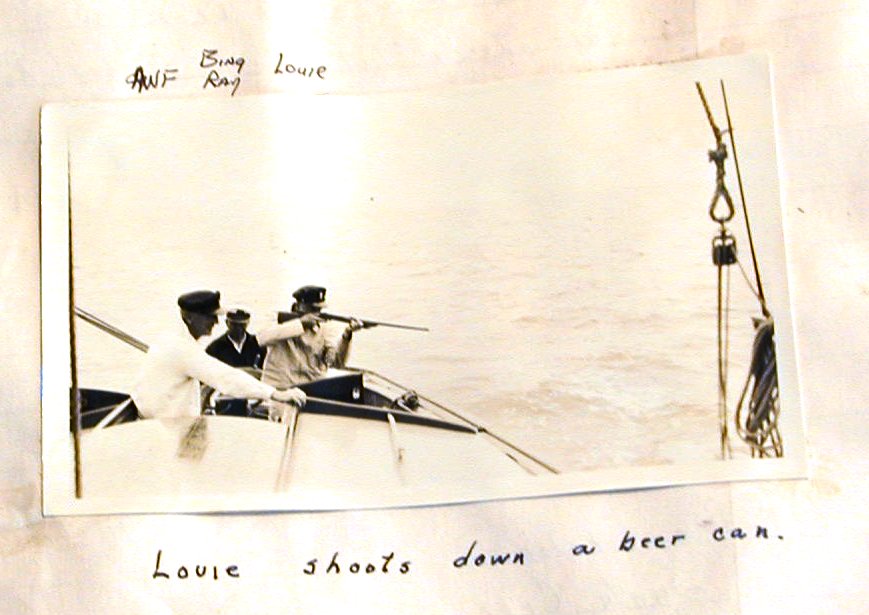
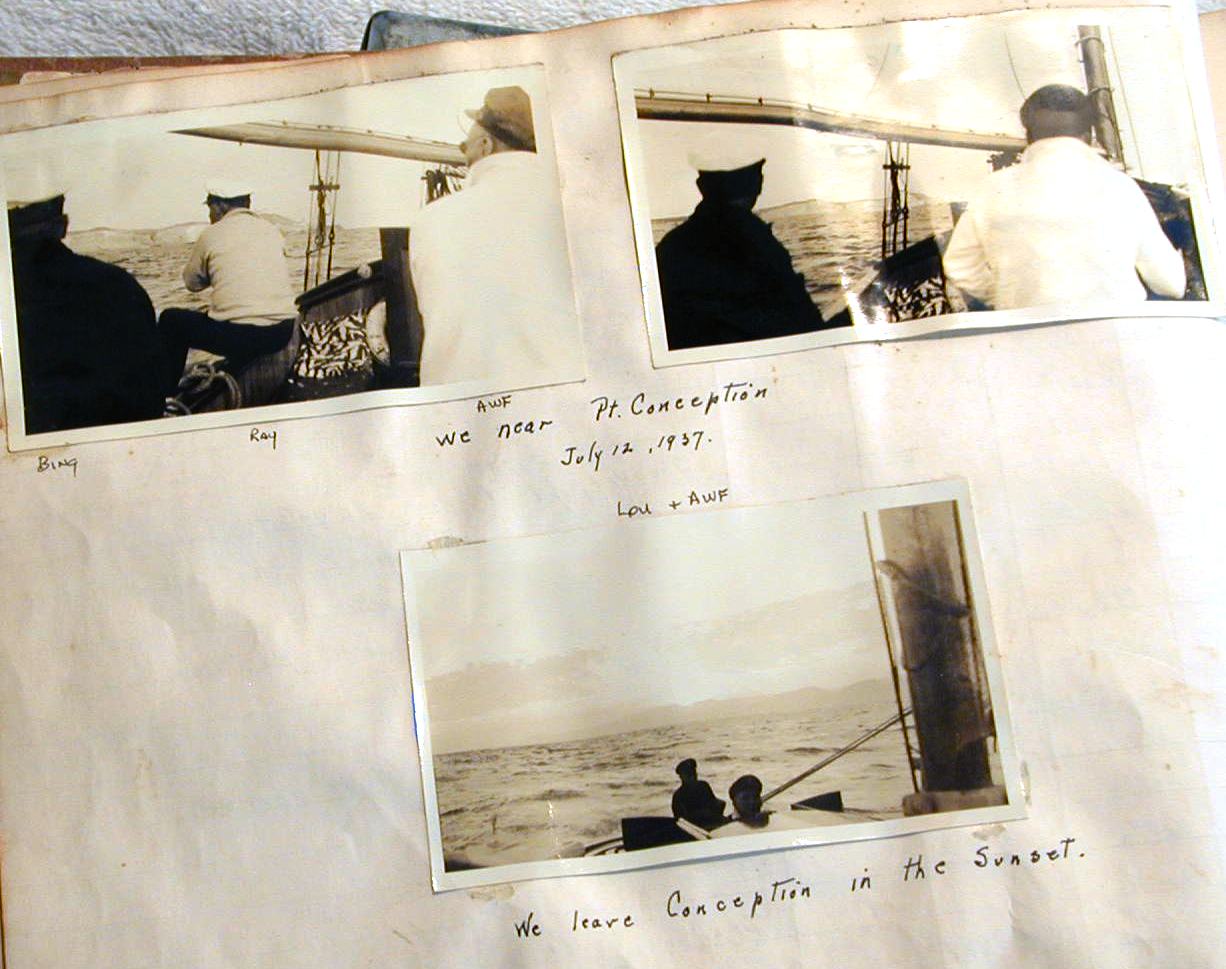
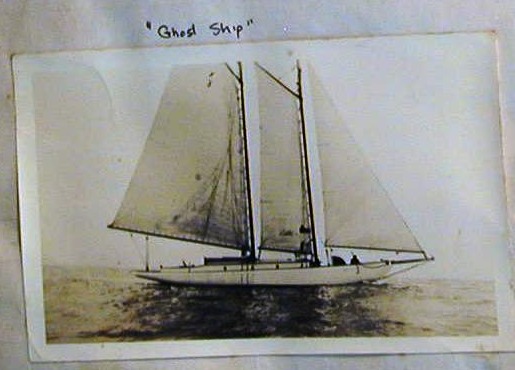
The voice of these pages is vivid, wry, and affectionate. “Cocktail hour — and very pleasant too.” “Louie sews on a button.” “A very strenuous day.” The log solemnly notes that the crew “felt landsick while shopping” in Santa Barbara; the return leg closes, at last light, “Enter S.F. yacht harbor — End of a fine cruise.” The album has a curious provenance twist: a page dated June 1985 records that at the Classic Boat Show, one of the 1937 shipmates, Bing Royce, came aboard and returned his log of the Santa Cruz Island cruise to Bob Ford, forty-eight years after the voyage. The epic, in other words, came home as a gift.
After the war the logbook turns to racing: the 1955 and 1957 seasons of “Yankee Weather” (Chapter VII), six newspaper clippings pasted proudly beside the entries. Then it thins through the 1960s and 1970s to occasional set pieces: the O’Connell clan’s outing of October 1966 (“Chicken assorted, Salad, ‘Booze !!!’”), the 1970 Master Mariners crew photograph, a salmon-fishing day that hooked eighteen and kept six. By the 1980s it is Dick Ford’s book — engine hours, fuel gallons, Tinsley transits, Bohemian Club cruises — and by the 1990s it belongs to the next generation, whose entries arrive in multiple inks and rising spirits: Kristina Ford’s twenty-sixth birthday under the Blue Angels during Fleet Week 1997; Ray O’Neal’s bachelor cruise (“ALSO ONE TOKEN LADY SAMANTHA FORD!!”); a guest writer’s languid September afternoon of seals, jellyfish, GMAT flashcards, and a game of Magic: The Gathering below decks — perhaps the only ship’s log in existence to record all four.
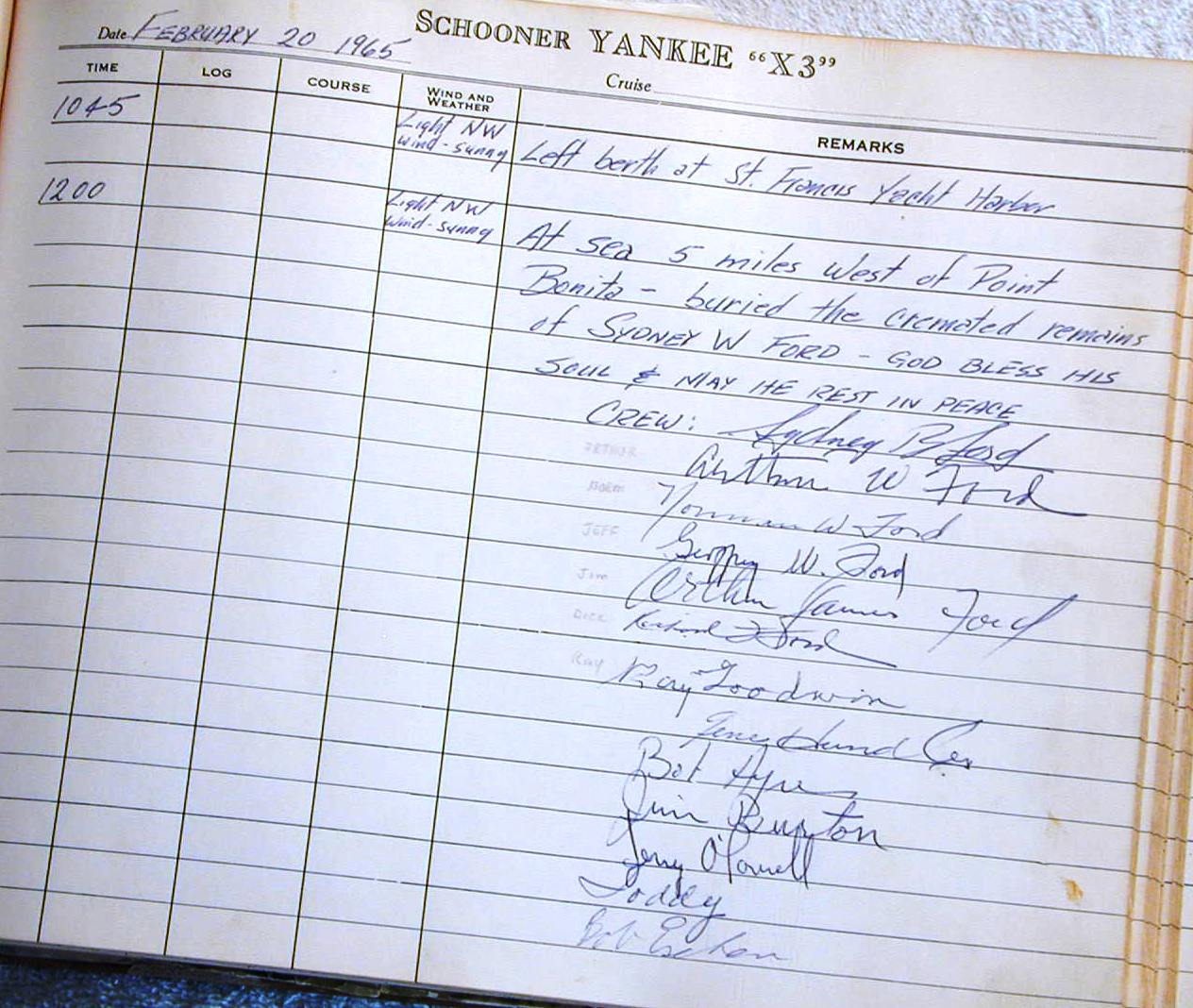
And braided through the decades runs the logbook’s gravest and most beautiful thread: the burials at sea. Eleven times between 1965 and 1998 the family committed the ashes of their own to the waters off the Golden Gate, most often at Boy Scout (Kirby) Cove, just inside the Gate on the Marin shore. The entries follow a ritual: the quiet departure, the ceremony noted in a line or two, flowers on the water, and then the log passed around so that everyone aboard could write a farewell. Sydney W. Ford, one of the two brothers who bought her, was first, in February 1965, buried five miles west of Point Bonita: “God Bless His Soul & May He Rest in Peace.” Bobby Ayres, the great helmsman, followed in 1982: “our friend, husband and father.” Ray Goodwin, who had dragged for the anchor at Potato Harbor, was scattered at his own request that September; his niece wrote, “A beautiful day for my favorite uncle!” Geoffrey Ford, the wartime skipper, joined “his brothers at rest” in 1984. Liz McNeill Ford in 1985; her father Rod McNeill in 1989, “joining his daughter Elizabeth and many friends, as he desired.” Robert Boone Davis in 1987: “8 bells for a talented & able young man who met an untimely end.” Lloyd Madigan, Bicentennial crewman, in 1994. And in October 1997, Robert D. Ford himself — the boy who had found her, the man who had raced her for seventy years — was taken out for “his final cruise aboard Yankee,” his page filled edge to edge with love.
The final entry in the logbook is the burial of Gerald Peter Francis O’Connell, Ellen Ford’s husband and the man who had devised the Yankee LLC to keep the boat in the family, on Sunday, August 23, 1998, at Boy Scout Cove, in weather the log column records simply as “Beautiful.” The family wrote on every line. “Perfect day for my husband!” “God only takes his best. Rest easy my friend!” “Goodbye Daddy — I love you & miss you so much.” And among the last lines in the book, one sentence that could stand as the motto of the whole hundred-and-twenty-year story: “Your spirit will always fill our sails.”
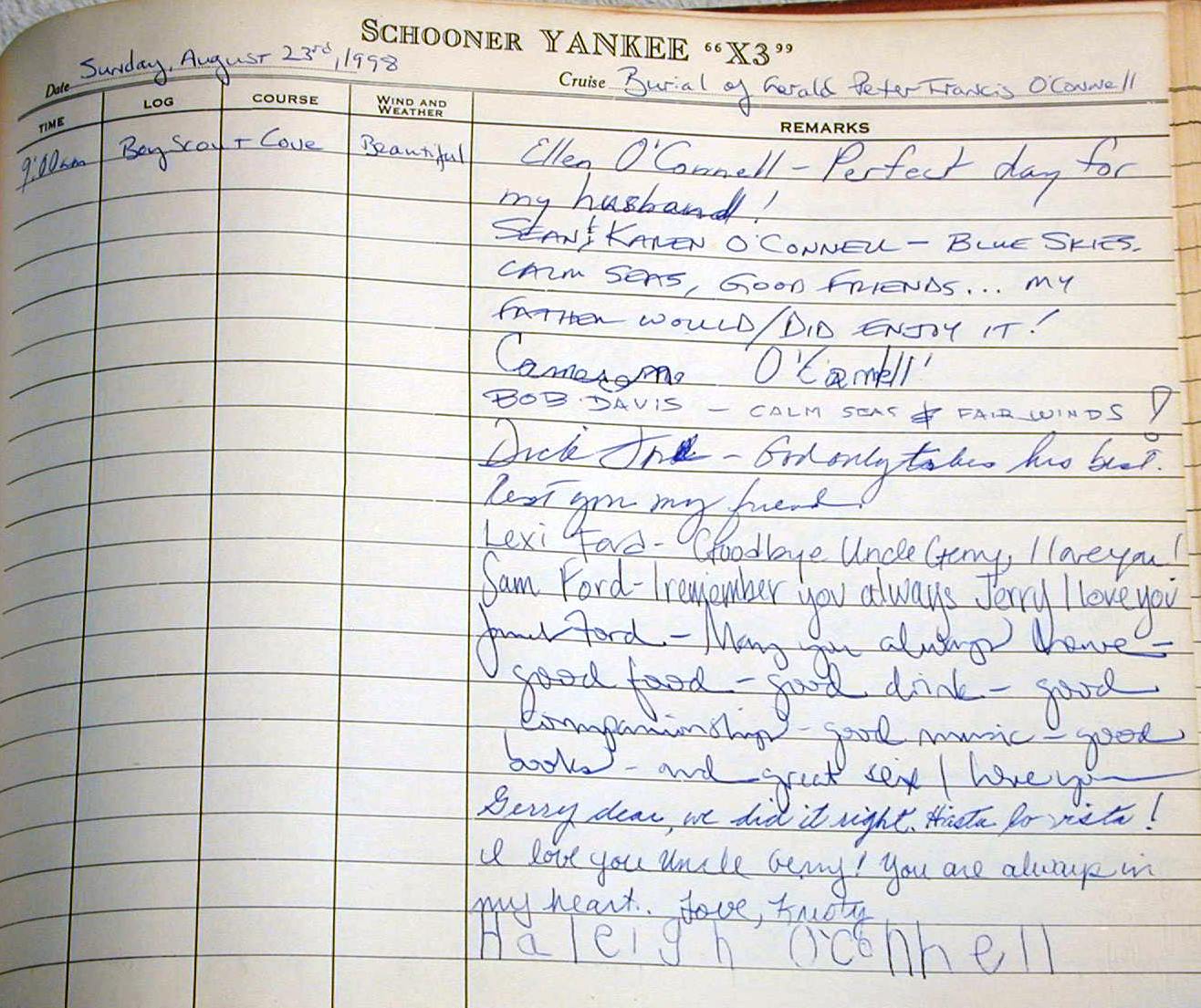
The logbook is not a complete record; the war years, most of the sixties, and many racing seasons are absent. Its value lies elsewhere: it is the only document in the archive that captures, in real time and in their own hands, what this boat meant to the people who sailed her. Not a vessel; a home.