Chapter VIII · 1996–2001
The Great Restoration
The Yankee LLC, an eighteen-month haul-out at KKMI, and a remarkable community effort.
By 1995, the ownership of Yankee had reached a crisis point. Robert Ford was elderly and suffering health issues. Dick Ford, a single father to three daughters after Liz’s death, could not carry the burden alone. Neither had been able to give the boat the time and care she required, and consideration was being given to disposing of her.
The solution came from brother-in-law Gerald O’Connell, with support from John McNeill. They proposed forming a limited liability company that would allow every member of the extended Ford family, across multiple generations, to share in the ownership and responsibility. Convincing Robert took a few meetings, but they succeeded. Ownership passed to the wider family, and The Yankee LLC was formed in February 1996. That spring the logbook announced Opening Day for “the ‘New’ Yankee” — new in her papers, if not a plank of her hull.
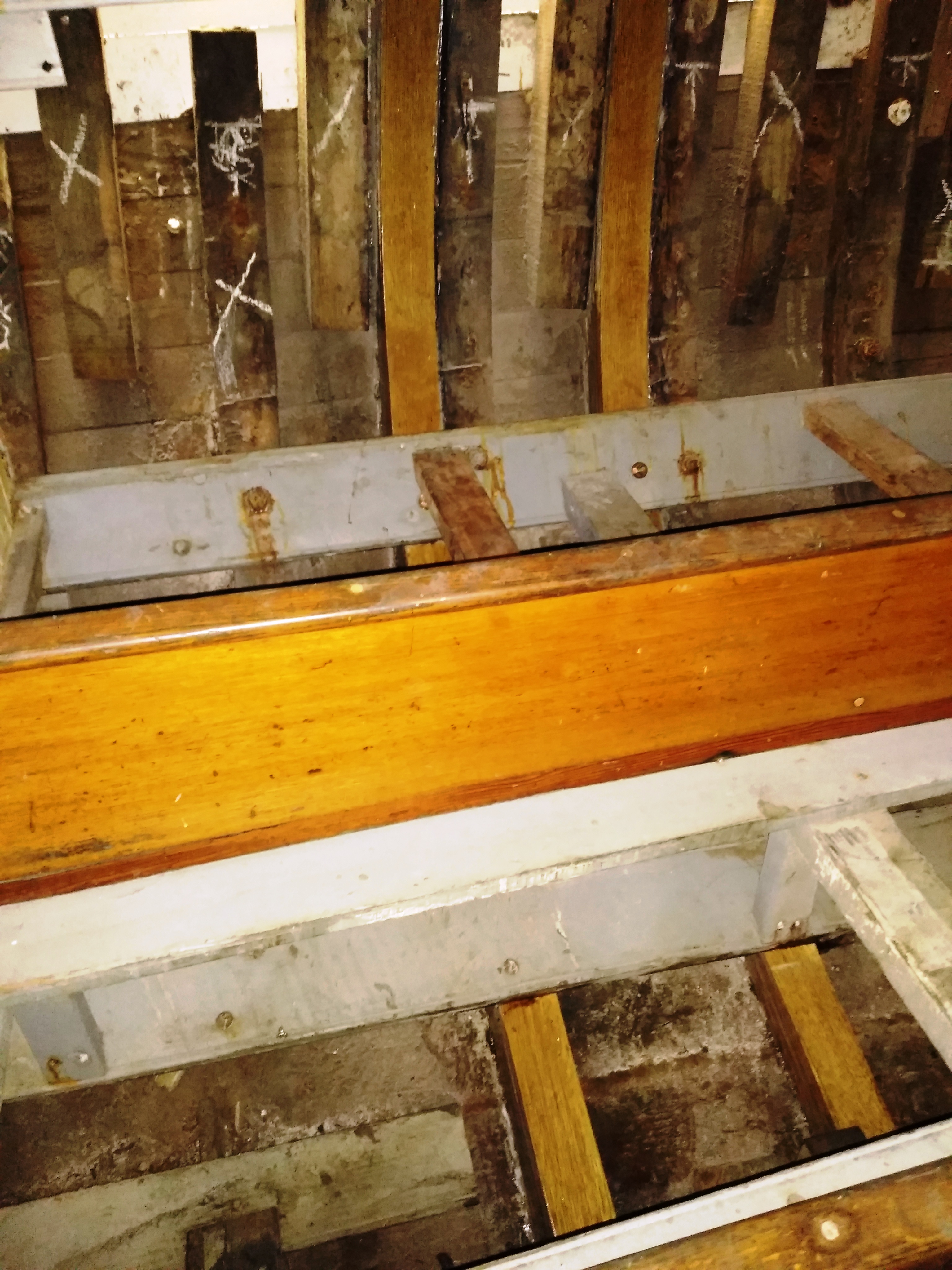
Almost immediately, the new ownership structure was tested. In August 1998 the logbook records her delivery to KKMI (Keefe Kaplan Maritime, Inc.) in Point Richmond for haul and survey (“Sunshine & salami sandwiches,” notes the scribe). What was expected to remain routine did not stay routine for long. In late 1999, back at KKMI for haul-out, a bit of rot found in the bow at the waterline prompted a deeper look; the crew returned the following weekend to an ugly surprise. The quick haul-out had become an eighteen-month restoration project and a serious financial challenge.
The scope of the work was daunting. The foremast had a massive rot pocket and had to be replaced entirely. A member of the family located an Oregon mill with suitable stock in its log pond, and a friend in the area had a lathe with a ninety-foot tail stock capable of turning a solid mast. Wisconsin white oak for new frames was hauled to Richmond by a friend with a trucking company. KKMI allowed the new mast to cure in their wood shop rafters for months.
But the Yankee crew had one great asset: strength in numbers. Three generations of family and friends turned out on weekends to perform every task they were capable of: scraping paint, pulling fasteners, doing rough woodwork. It was, by all accounts, a remarkable community effort. McNeill put the family’s spirit plainly: “Our sister Yankee was sick, and we had to step up and take care of her, as she had taken care of us for so many generations.” The boat’s sense of occasion survived intact: she attended the 2000 Stag Cruise mastless, under power, a patio umbrella rigged in the cockpit for shade, prompting one boat coming up False River to report, McNeill swears, that a submarine was attacking him.
Yankee was finally launched and, after a few days of soaking to allow the seams to swell shut, headed home to her berth. Photographs of the restored vessel taken for a wooden-boat calendar around 2000–2001 show her in prime condition — railed down and driving, long and slender in the water. That same sail produced a harrowing coda: a forty-knot gust off Fort Point laid her on her beam ends, water pouring in at the house ports, the main boom dragging. She rolled back up and stood on. “Thank God we’ve made her a sound boat again,” McNeill remembers thinking. “She is solid.”